

Good morning, friends.
One Christmas a few years ago, my mom gave me a book titled, Life Stories. It’s a compilation of The New Yorker’s greatest longform profiles.
The first line of the book reads, “One of art’s purest challenges is to translate a human being into words.” That sentence has been on my mind ever since I read it, and as a writer who specializes in profiles, there’s no greater challenge.
There are layers on layers to a human being. And to think that you could deconstruct someone’s essence into 4,000 words is naive, and frankly, silly. But there are some profiles that capture the complexities of that elusive je ne sais quois in a way no one has been able to before*.*
One writer who is able to capture it is named Wright Thompson. He wrote this epic 2016 ESPN profile on Tiger Woods.
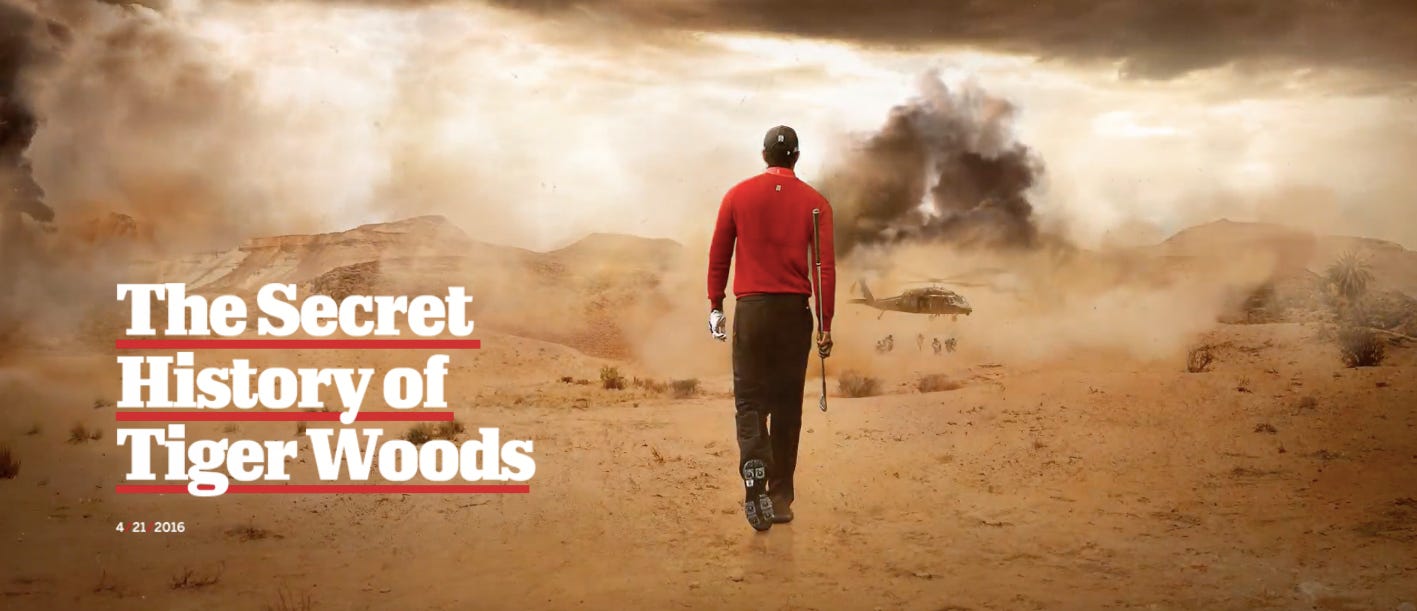
Let me preface this by saying that it’s about Tiger Woods, but it’s not really about Tiger Woods. It’s about anyone who has ever experienced profound loss, grief, and inexplicable loneliness.
In the 10 years since his father died, Tiger lost his greatness at golf, while becoming obsessed with the military and indulging in a dozen or more affairs — both reflections of his dad Earl. All kids, the story says, whether they love or hate their fathers, want to shake free of the past and overcome any inherited weakness. Tiger’s father seemed to evoke conflicting emotions: The best and worst things that have happened in his life happened because of Earl.
Tiger grew up without any siblings or many friends and spent his childhood with his father, either on the golf course or hitting balls into a net in the garage. They often butted heads, but their biggest, most serious fight centered around Earl’s love for women. Tiger hated that his dad cheated on his mom. Yet somehow, Tiger’s life unraveled in a way much like his father’s, and he found himself repeating the same mistakes.
We never see the past coming up behind because shaping the future takes so much effort. That’s one of those lessons everyone must learn for themselves, including Tiger Woods. He juggled a harem of women at once, looking for something he couldn’t find, while he made more and more time for his obsession with the military, and he either ignored or did not notice the repeating patterns from Earl’s life. “Mirror, mirror on the wall, we grow up like our daddy after all,” says Paul Fregia, first director of the Tiger Woods Foundation. “In some respects, he became what he loathed about his father.”
And that’s the thing — the past always sneaks up on us when we least expect it. We unknowingly pick up our parents’ habits, fall into old patterns, and get nostalgic about how things used to be.
The thing that struck me about the profile is that so many people expected Tiger to act a certain way because of his status. But he almost never behaved in accordance with social norms, and that made him, well, “a weird f---ing guy,” as one Navy SEAL put it.
This is a remarkable story of early success, a meteoric rise, a catastrophic fall, and an uncertain future. But it’s mostly a reminder that humans are complex creatures, and the unpredictable forces of life can bring anyone to their knees.
Wright Thompson — the writer of the piece — recently appeared on a podcast in which he discussed what a profile’s really about. He said: “Profiles are about figuring out what is a central complication of somebody’s life and how, on a daily basis, they go about solving it.”
It sounds simple, almost obvious, until you realize how rarely profiles actually do this. The best profiles reveal the problem the subject is trying to solve, and why a person’s decisions that seemed erratic start to feel inevitable.
Right now, I’m working on a profile of two people who have spent their entire adult lives in public. On the surface, their story seems like it is about attention. I was struggling to write the piece until I realized that the attention is actually not the complication of their life. It’s a need for a scoreboard that’s concrete enough to silence the doubters, the haters, and all the people who want to see them fail.
And so every day becomes a kind of experiment in solving that problem.
Thompson’s framing becomes useful because it forced me to look past the spectacle and ask: “What are they trying to fix?”
My hope is that the profile answers it.
— Polina
PROFILES.
— Apple’s next CEO [**HIGHLY RECOMMEND**]
— The billionaire who wants to reshape Miami
— The most prolific reporter in media
— The woman who alerts the world when an asteroid could hit
— The designer helping men dress better
PEOPLE TO KNOW.
Apple’s next CEO: Apple is entering a leadership transition as longtime executives retire, with John Ternus emerging as the top candidate to succeed Tim Cook. Ternus is a respected operator who has helped steady Apple’s core products, but his rise raises this question: Can a company built on iteration find its next breakthrough, especially as it falls behind in AI?
The billionaire who wants to reshape Miami: Ken Griffin is betting Miami is the future of American capitalism, citing its speed, pro-business culture, and openness to growth. The Citadel CEO has turned that belief into power by building Citadel into a financial giant while emerging as a key voice in shaping Republican economic policy. Now, he’s pushing a broader vision of low-regulation, pro-immigration capitalism and positioning himself to help lead it. (FORTUNE)
“The fight in America is all about protecting the cultures in places like Miami or Silicon Valley, and keeping us a nation of entrepreneurs.”
The most prolific reporter in media: Nick Lichtenberg is using AI to produce more stories in days than many reporters do in months. At Fortune, his AI-assisted work now drives a significant share of traffic, offering a glimpse into how legacy media is adapting to survive. His approach is all about scaling speed and output while risking accuracy, trust, and the very definition of reporting. (WSJ; complimentary link)
“It’s like a sports car that you can crash if you’re not careful. You’ve got to be like a Formula One driver.”
The woman who alerts the world when an asteroid could hit: Aarti Holla-Maini, the little-known UN official in charge of planetary defense, found herself confronting a real “Armageddon” scenario when an asteroid briefly threatened Earth. Trained for simulations, she had to quickly coordinate a global alert to 193 countries — testing, for the first time, the world’s response system to a potential space disaster. The moment revealed how much responsibility rests on a small, under-the-radar team—and how thin the line is between routine monitoring and global crisis. (The Guardian)
“This wasn’t a simulation or a drill. It was real.”
The designer helping men dress better: Todd Snyder has built a thriving fashion brand by offering high-quality, Italian-crafted style at prices that don’t feel absurd. As luxury brands lose millions of customers amid soaring prices, Snyder is winning by occupying the middle — delivering classic, wearable clothes that feel elevated but attainable. His bet is that most men want to dress better, just not at the cost — or risk — of high fashion. (Bloomberg; alternate link)
“I’ve always been about creating something that is attainable.”
✨ The rest of this newsletter is only available for premium members of The Profile, whose support makes this work possible. If you’re not already a premium member, consider upgrading your subscription below for access to an additional section of weekly audio + video recommendations. ✨
