

It has taken me a year to write about the best and worst day of my life. I’ve tried several times before, but I would get a few paragraphs in, feel my heart start racing, and shut my laptop.
Let’s try this again.
When I got a positive pregnancy test last February, my husband and I were ecstatic. We were about to have a third child. A few days later, we went to the doctor expecting the routine excitement of hearing a heartbeat for the first time. Instead, we discovered I was pregnant with identical twins.
Shock. Disbelief. Excitement.
The celebration lasted less than a minute.
As the doctor congratulated us, she kept moving the ultrasound probe back and forth across the screen. At first I thought she was simply being thorough, but after a while it became obvious she was looking for something she couldn’t find.
She explained that she couldn’t see a membrane separating the babies. If that was true, the twins were sharing a single amniotic sac, making the pregnancy extraordinarily high risk. (She later told us that the only thing riskier would have been conjoined twins.)
After what felt an excruciatingly long time, she turned on the bright overhead lights, looked directly at us, and said, “Let’s talk.”
I immediately started shaking because the energy in the room had changed so dramatically. She explained that without a membrane, the babies would likely be born extremely prematurely and could face severe neurological complications. Then she said the sentence I still have nightmares about: “This is the time when most people choose to terminate the pregnancy.”
Shock. Disbelief. Terror.
As someone who writes for a living, I rarely struggle to describe a feeling. This is one that’s simply impossible to explain.
Even now, as I write these words, my body reacts exactly as it did that morning. The best way I can describe it is a strange cocktail of dread, grief, anger, disbelief, and a physical nausea that made me feel like I might collapse. The only thing I remember managing to say was, “Are you sure? Maybe it’s just too early to see it?” She told me she had looked carefully and was pretty sure there wasn’t a membrane.
She handed me the ultrasound images. My hands were shaking as I took them, and we walked out of the office. I think it was a sunny New York morning, but I honestly couldn’t tell you. All I saw was gray. I don’t remember what I was thinking on the walk home. I only remember the overwhelming feeling that I was about to throw up.
When we got home, I put the ultrasound photos into a kitchen drawer and sat on the couch staring at nothing. After a few minutes, I felt an overwhelming urge to look at them again. I still can’t explain where that impulse came from. All I can say is that I believe in God, and I believe something beyond me got me off that couch.
I pulled the images back out and started studying them one by one. On the first image, I thought I saw a faint curved line. Then I saw it again on the second. And the third. And then I started Googling images of ultrasounds. I saw that ultrasounds of twins sharing one amniotic sac didn’t look like mine. Ultrasounds of twins with separate sacs did. They all had the same faint line I thought I was seeing.
This all happened during the first week of March 2025. I knew what ChatGPT was, but I hadn’t really used it in any meaningful way. So I took a picture of the ultrasound, drew an arrow toward the faint line, uploaded it, and asked the simplest question I could think of: “Hi! What is that line the arrow is pointing to?”
ChatGPT identified what appeared to be a membrane.
My immediate reaction was that it had to be wrong. There was simply no way a machine had spotted something that an experienced physician had spent ten minutes looking for. But I couldn’t stop thinking about it. I barely slept that night. The next morning, I uploaded the ultrasound to the patient portal and asked the doctor what the line represented.
There was no response.
I left the apartment exhausted and so very numb. I was waiting to cross the street when I caught my reflection in the glass of an office building. I looked awful. Then, almost as if the words weren’t mine, I heard this sentence in my brain: “In this moment, everything is okay.”
For the first time since the appointment, I felt a strange sense of peace. In that moment, everything was okay. The babies had strong heartbeats, they were developing normally, and nothing had actually happened yet. My mind had traveled weeks and months into an imagined future, but in that moment, everything was okay.
A few hours later, my phone rang. It was the doctor. “I don’t know how I missed that,” she said. “I can’t say for certain what it is, but it does look like there’s a membrane.”
Normally I’m quick to forgive people. This time, let me tell you, it was hard. It wasn’t that she had missed something — obviously doctors are human. It was the casualness with which she delivered the news and the complete absence of an apology. I could feel my blood pressure rising as one thought repeated in my head: “You robbed me of the best day of my life.”
Needless to say, I never went back to that practice. I transferred to a maternal-fetal medicine specialist. They confirmed there was, in fact, a membrane separating the twins. The pregnancy was no longer considered the rare, ultra-high-risk scenario we had been told to expect.
It still required careful monitoring because the babies were identical, but the outlook changed dramatically. I went on to have a healthy pregnancy until 36 weeks and 4 days. (The insanity of their birth is a story for another time.)
Looking back now, I realize the biggest lesson had very little to do with the doctor or even ChatGPT. It’s a story about how quickly the human mind rushes toward certainty when certainty doesn’t exist.
Even after switching doctors and hearing reassuring news at every appointment, I caught myself doing it over and over again. What if this happens? What if that leads to something worse? What if we’re the exception? I was constantly living inside second- and third-order consequences of events that hadn’t happened — and, as it turned out, never would.
One day, sensing where my thoughts were going, my new doctor stopped me mid-sentence. “You know what?” she said gently. “I’m not going to let you do that. Right now, everything looks good.”
I got goosebumps the second those words came out of her mouth. It was a version of the words I had heard standing at that crosswalk: “In this moment, everything is okay.”
I’ve thought about those words often over the past year because I’ve realized they apply to more than just pregnancy. Whenever my mind starts catastrophizing about work, my family, my health, or the future, I notice that I’m almost always trying to solve problems that don’t exist. I’m fearful about a future I haven’t lived.
That doesn’t mean bad things won’t happen. Sometimes they do. But I’ve learned there’s a massive difference between preparing for reality and suffering through imagination.
Today, those babies turned one year old.
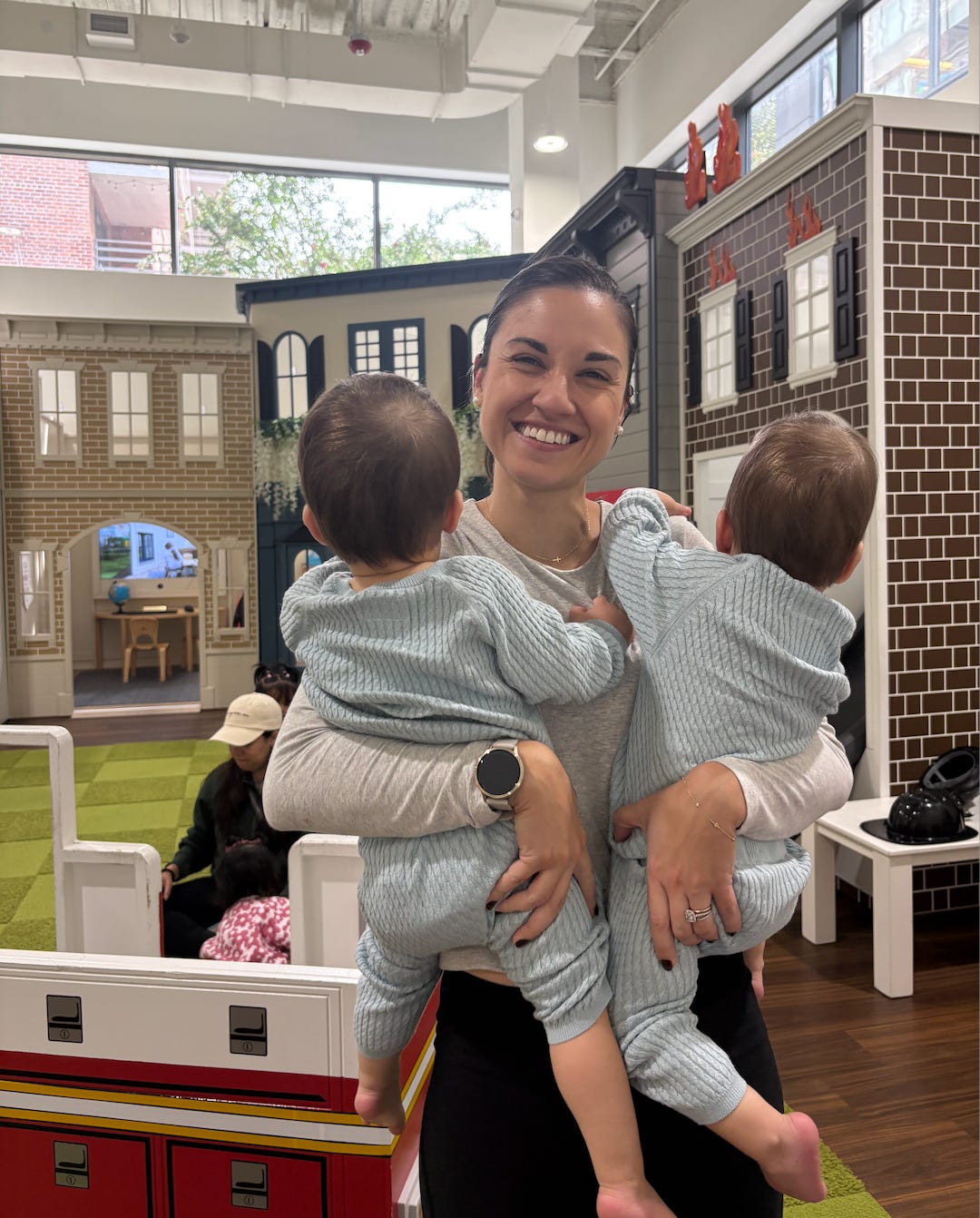
They’re healthy, they’re happy, they’re curious, and most of all, they are here. They spend their days crawling around the apartment, laughing, clapping, and reminding me how wrong that first prediction turned out to be. Every day that I look at them, and I’m thankful for another uneventful, ordinary day.
And whenever I catch myself ruminating about an imagined future, I come back to the sentence that carried me through one of the hardest weeks of my life: In this moment, everything is okay.