

Good morning, friends!
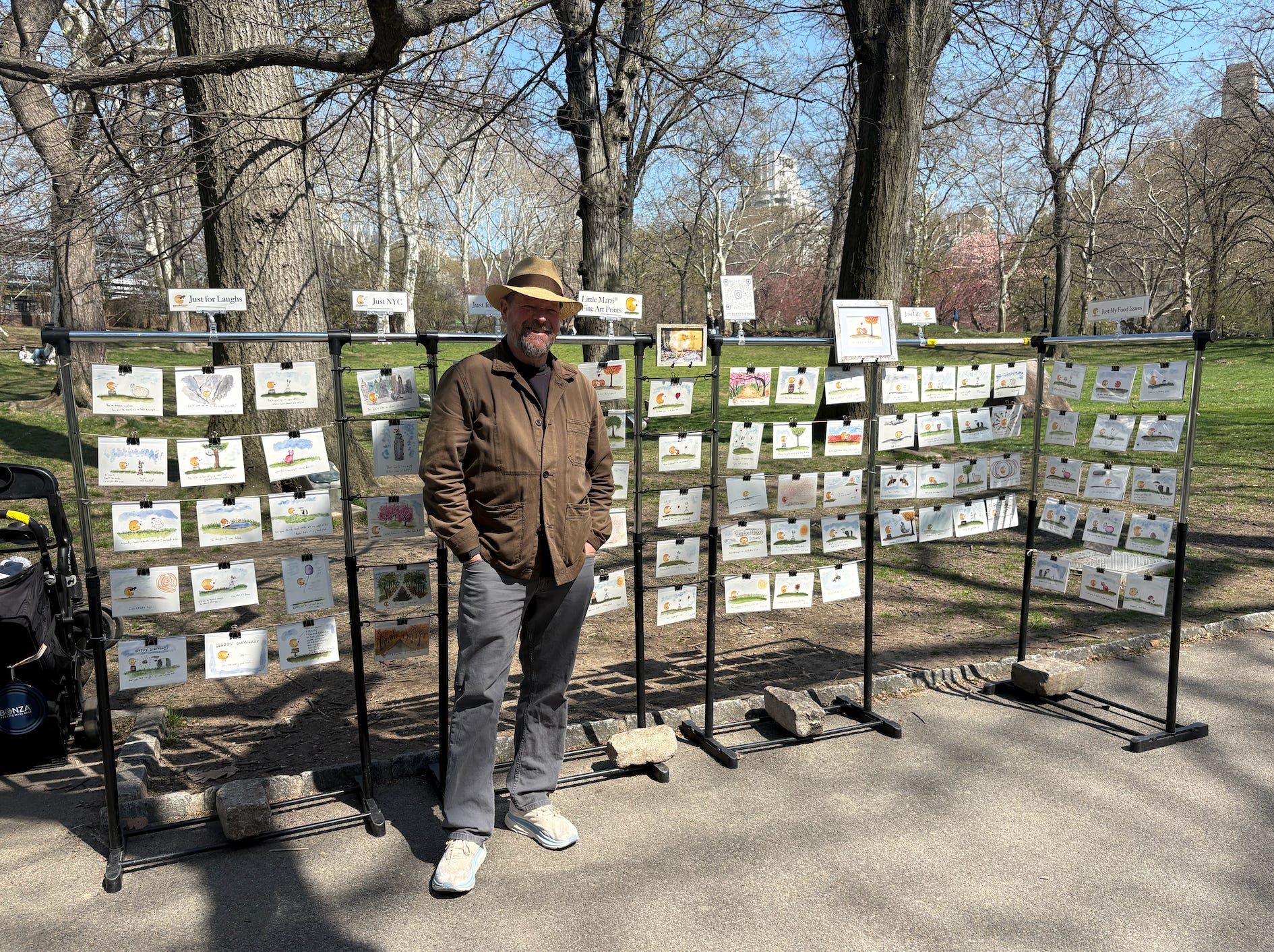
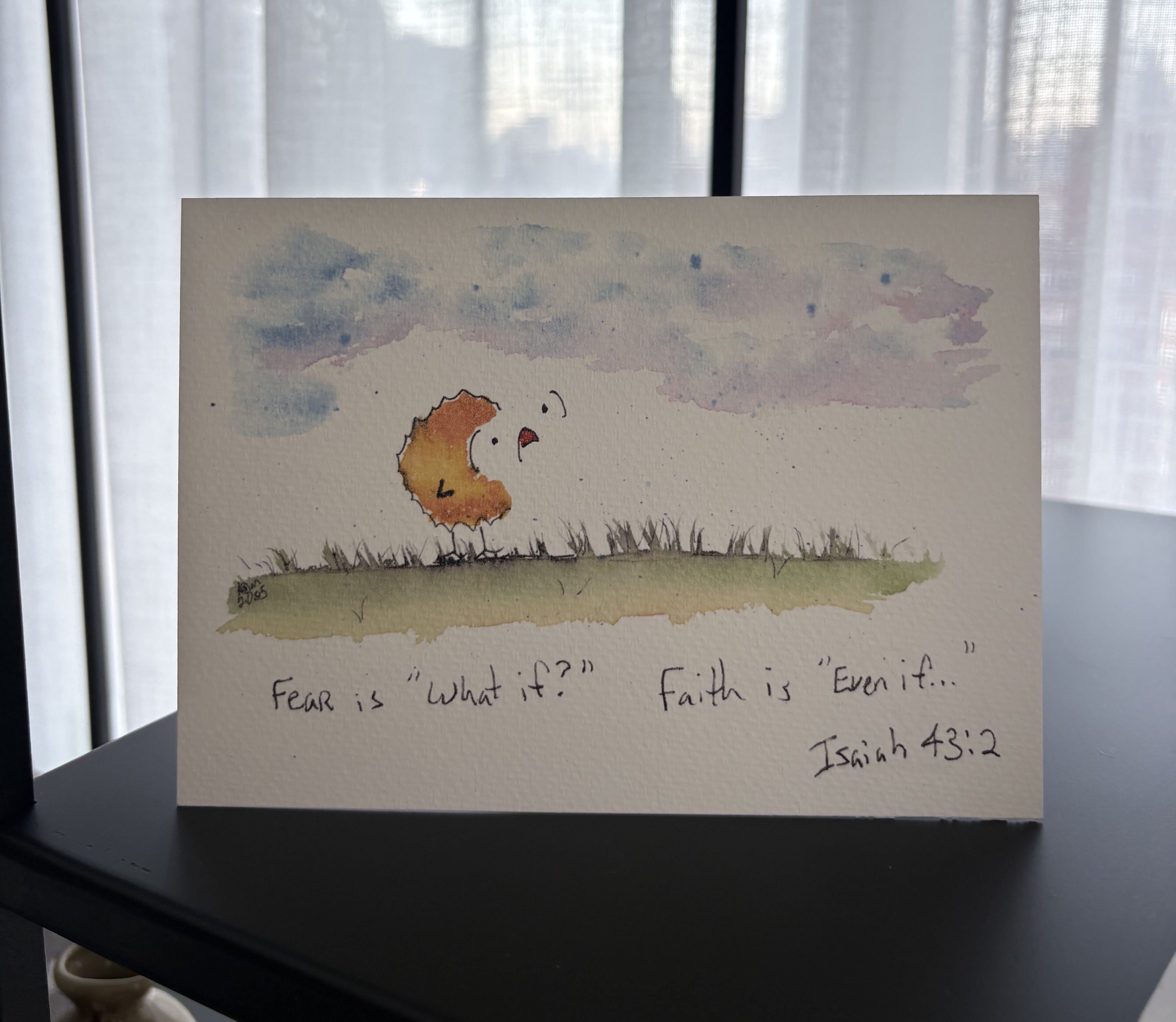
On a recent walk through Central Park, I stopped in front of a display of watercolor paintings of a chicken — a small, yellow, wide-eyed bird, each one paired with a line of scripture or a simple, handwritten quote.
The artist, Alex Mebane, told me the cartoon chicken was once real. His daughter named it “Marzipan,” eventually shortened to “Little Marzi,” and it became his muse.
I’ve written before about “weak social ties” — the casual relationships with people you encounter in coffee shops, bookstores, or on your daily walk — and how they can quietly magnify your happiness. This felt like one of those moments.
I stood there longer than I expected. There was something paradoxical about it — the simplicity of the image paired with the weight of the words.
When I asked Alex how much the paintings cost, he told me: “You pay me whatever you want. This is such a weird gift from God that he knows what I need.”
Today is Bulgarian and Greek Orthodox Easter, and it made me think about the nature of faith. I saw its power firsthand when my newborn twins were in the NICU. I’ve seen it again in friends going through difficult seasons.
And now, I saw it in the way Alex had turned his hardest moments into something unexpectedly bright. A belief in God carried him through the darkest stretches of his life.
For me, believing in God has always been a source of strength — the kind you don’t realize you have until you need it.
Of course, I asked Alex more questions, and I’ve shared his answers below. If you feel inclined, you can check out his work here or find him in Central Park.
Q: How did this become your life’s work?
ALEX: In 2016, my family had moved to Austin from Santa Monica and getting backyard chickens seemed like a fun idea. Marzipan (named by my youngest daughter), the main character to my paintings, was the only yellow chicken and a bit odd. Granted, ALL chickens are odd but she was more so. After a year, I moved back to Santa Monica to resume my career in entertainment. Then Covid happens, and I’m not working. A friend was painting water colors live on Facebook and I joined purely out of “something to do.” I envisioned perhaps writing a children’s book with Marzi (that’s usually what we called her) as the main character. I broached the subject with my painting friend and he responded, “I’ll teach you how I do watercolors.” So in 2020, my life as an artist began. The first couple of hundred looked like I had painted them with my foot. But they got better.
What drew you specifically to New York City and Central Park?
ALEX: Julia Cameron’s The Artist’s Way profoundly influenced both my painting and my move to New York. One of her exercises was to do a vision board and unfortunately, nothing I chose for it was in California. My grandparents had lived here in NY when I was young, and I always thought of NYC as a magical place. And still do. I figured I would just get a new agent and go back to working in entertainment.
I loved Central Park as a child and visited here not long before I moved here in 2022 and met a girl near the Bethesda Fountain doing poetry for strangers. She told me a permit wasn’t required to vend there along the Mall, so after I moved here in June of 2022, I gave it a shot. And oddly enough, people responded in a way that I didn’t expect.
Faith seems central to what you do. Has that always been true, or did it emerge over time?
ALEX: I’ve been a Christian for 50 years, and it’s always found its way into what I create. More than a few of my paintings I sell here in the Park came from struggle. LA was a hard period for me. I had some success (I sang on some Disney children’s albums, won a Los Angeles Emmy for a children’s show I’d help produce), yet consistent work was difficult to find.
Also, during the pandemic, I read an article by a pastor from Philadelphia, Paul David Tripp, about dealing with hopelessness, from which I was struggling. One of the suggestions was, “Be the encouragement you need to hear.” So some of what I paint is that. Hope my own heart needed to hear.
You let people pay whatever they want for your work? Why do it that way?
ALEX: Honestly it’s such a weird gift from God, (I had never painted anything before the pandemic other than a wall) and the reality, God knows what I need. It’s how I’ve made a living for the past 4 years. I often joke, following the Lord is a lot like the mapping app Waze. It takes you on paths that seem totally opposite of where you want to go, but you end up exactly where you were supposed to be, at exactly the right time.
—-
My dad often tells me: “Sometimes God helps us, and other times, He uses us to help others.” I’ve come to believe that the highest form of faith is the kind that extends beyond yourself — helping others, even in the smallest ways.
Below is a ‘day in the life’ video of how Alex makes a living selling chicken paintings:
PROFILES.
— The OpenAI CEO who may control our future [**HIGHLY RECOMMEND**]
— The nuclear engineer who started the sports betting revolution
— The people who live on an isolated island
— France’s tech hub trying to win the AI race
— The luxury reading retreats
PEOPLE TO KNOW.
The OpenAI CEO who may control our future: At OpenAI, the question isn’t just what Sam Altman is building, but whether he can be trusted to control it. Inside the company, allies see a brilliant operator; critics see a leader willing to bend the truth to win. As A.I. inches toward world-shaping power, that tension has turned one man’s judgment into a global risk. (The New Yorker; alternate link)
The nuclear engineer who started the sports betting revolution: A bored engineer turned a mainframe into a money-printing machine while accidentally rewriting the rules of sports betting. Mike Kent’s algorithm gave his crew an edge so powerful it drew the mob, the FBI, and millions in wagers into its orbit. But as the winnings piled up, so did the risks, until the operation collapsed under betrayal, paranoia, and federal scrutiny. (Bloomberg; alternate link)
The people who live on an isolated island: On Tristan da Cunha, the most isolated inhabited island on Earth, there’s no such thing as a quiet life. With just 221 residents and no way in or out except by sea, survival is a full-time, all-hands operation. Everyone does everything—and the island only works because no one opts out. What a fascinating article. (NPR)
COMPANIES TO WATCH.
France’s tech hub trying to win the AI race: At Station F, France built a startup campus to showcase its tech talent. Now, it’s trying to win the global AI race. Backed by political power, elite founders, and deep-pocketed partners, the campus has become a magnet for ambition and capital. But turning that momentum into lasting global dominance means closing the gap with Silicon Valley’s speed, scale, and mindset. (Thomas Yeddou Substack)
The luxury reading retreats: Reading, once a social ritual, is being reinvented as a luxury escape. Across the US and UK, people are paying up to $1,000 to sit in silence with strangers. The appeal is supposedly about reclaiming attention, community, and the rare feeling of being fully present. (Bloomberg; alternate link)
✨ The rest of this newsletter is only available for premium members of The Profile, whose support makes this work possible. If you’re not already a premium member, consider upgrading your subscription below for access to an additional section of weekly audio + video recommendations. ✨
